

 GPS & GNSS
 Lidar scanning
 Total Station
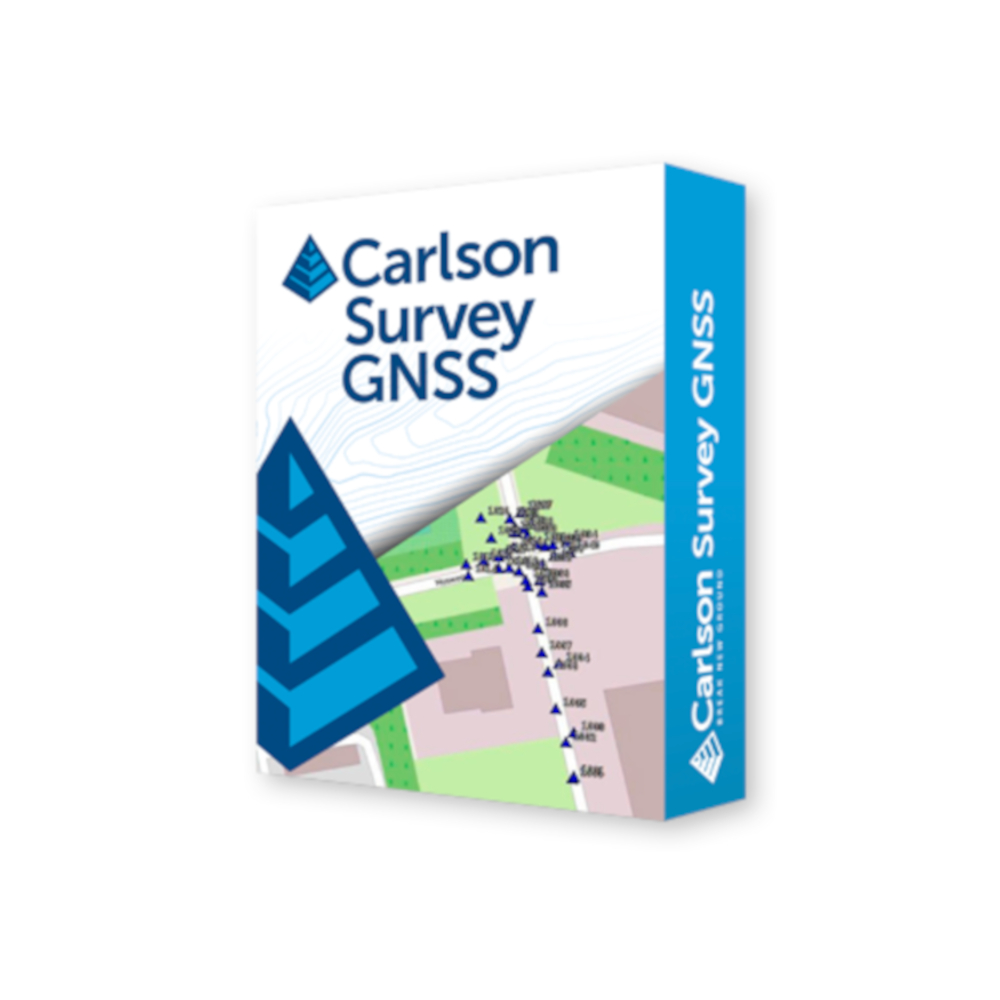
Carlson SurveyGNSS Post Processing Software
Get the best price for your setup
Contact our experts for the best possible price and configuration.
- Fast response
- Expert configuration advice
- No overpaying for features you do not need
Carlson SurveyGNSS 3 is professional GNSS post-processing software for surveyors, engineers, GIS professionals and positioning specialists who need to calculate accurate positions from raw satellite observations. It processes static, stop-and-go and kinematic GNSS data, making it useful when RTK corrections are unavailable, unreliable or when an independent quality check is required.
SurveyGNSS accepts RINEX data from virtually any GNSS receiver as well as a range of manufacturer-specific raw formats. The software calculates GNSS vectors, helps assess observation quality, performs least-squares network adjustment and can retrieve reference-station information for post-processing. Version 3 also introduces multi-thread processing and selectable sample intervals to speed up larger datasets.
Carlson SurveyGNSS 3 Highlights
| Processing modes | Static stop and go and kinematic GNSS post processing |
|---|---|
| GNSS constellations | GPS GLONASS Galileo BeiDou and IRNSS support with compatible observation data |
| Data compatibility | RINEX 2 and 3 plus multiple proprietary receiver formats |
| Network processing | GNSS vector calculation and rigorous least squares adjustment |
| Reference data | Search and retrieval of supported reference station observations and precise ephemeris data |
| Version 3 workflow | Multi thread processing selectable sample intervals and baseline processing transcripts |
You may also like…













Valued customers:










Find RTK Networks
Search NTRIP providers and connect to reliable RTK correction services.
Description
Carlson SurveyGNSS 3 GNSS Post Processing Software
Carlson SurveyGNSS 3 is GNSS post-processing software designed for land surveyors, geodetic professionals, engineers and GIS users who need to calculate accurate positions from raw satellite observations after fieldwork has been completed. It provides an alternative or additional workflow to real-time RTK by processing stored GNSS observations against another receiver or suitable reference-station data.
This makes SurveyGNSS particularly useful when a project is outside reliable RTK network coverage, when the mobile data or radio link is unstable, when additional quality assurance is required or when observations need to be processed again using different reference information. Rather than depending entirely on a correction arriving in real time, the raw GNSS data can be taken back to the office and evaluated before final coordinates are accepted.
Process Static Stop and Go and Kinematic GNSS Data
SurveyGNSS supports several common post-processing methods. Static observations can be used for survey control and other work where receivers occupy known or unknown points for a period of time. Stop-and-go processing suits workflows where a rover remains stationary at individual survey points before moving to the next location. Kinematic processing handles observations collected while the receiver is moving.
For a surveyor, this means the same office application can be used for different types of GNSS fieldwork. A control network, topographic survey and moving-rover dataset do not necessarily require separate post-processing programs.
Useful When RTK Corrections Are Unavailable
RTK is fast and practical when a stable correction source is available, but not every site has reliable network coverage or radio communication. SurveyGNSS provides a way to continue collecting raw satellite observations and process them later instead of making the complete survey dependent on a live correction connection.
This can be valuable in remote areas, on large sites near the edge of a correction network or on projects where temporary communication problems would otherwise interrupt the work. Post-processing can also provide an independent check for important control points that were originally measured with RTK.
RINEX Support for GNSS Receivers from Different Manufacturers
SurveyGNSS accepts GNSS observations in the industry-standard RINEX format, including RINEX 2 and RINEX 3 data. Because RINEX is designed as a receiver-independent exchange format, observations from many different GNSS receivers can be processed without tying the office workflow to a single hardware brand.
The software also supports a range of proprietary observation formats from manufacturers including Carlson, Hemisphere GNSS, Altus, Javad, NovAtel, FOIF, Leica, NVS, Septentrio, Sokkia, Topcon, Trimble and u-blox. Support for a particular raw receiver file can depend on the relevant format and available conversion tools, so RINEX remains a useful common format when combining equipment from different manufacturers.
Multi Constellation GNSS Processing
Current SurveyGNSS processing supports observations from the major GNSS constellations including GPS, GLONASS, Galileo and BeiDou when suitable receiver data is available. Carlson also documents support for the Indian Regional Navigation Satellite System, now commonly known as NavIC or IRNSS.
Multi-constellation data can be particularly useful where the field receiver tracks a large number of satellites. More usable observations can improve the geometry available to the processing engine, although the final quality still depends on factors such as multipath, obstructions, observation time, satellite geometry, antenna setup and baseline length.
Calculate High Quality GNSS Baselines
At the centre of SurveyGNSS is its baseline processor. The software compares simultaneous code and carrier-phase observations between GNSS stations and calculates vectors between them. Carlson specifies automated ambiguity resolution and cycle-slip detection and removal as part of this processing workflow.
Once a vector has been processed, the results can be inspected rather than treated as a simple pass or fail measurement. Information such as solution status, baseline length and quality indicators helps an experienced surveyor determine whether the observation is suitable for the accuracy required by the project.
Faster Processing in SurveyGNSS Version 3
SurveyGNSS 3 introduces multi-thread processing so multiple baselines can be calculated simultaneously where the computer hardware allows it. This can reduce processing time on projects containing many observations compared with handling every baseline sequentially.
A processing sample interval can also be selected independently of the interval used while recording the field data. For example, a long observation recorded every second can be processed at a longer interval when appropriate, reducing the amount of data that needs to be calculated. Carlson currently provides 5, 15, 30 and 180 second processing interval options.
Version 3 also provides a dedicated baseline processing transcript view. This gives survey professionals more information about what happened during the calculation and can be useful when examining results that require additional review.
Use Reference Station Data for Post Processing
SurveyGNSS can search supported geodetic reference networks for published GNSS observations and known control information. Instead of always setting up and operating your own base receiver beside the project, suitable continuously operating reference station data can be used where it is available and appropriate for the survey.
For users working with the United States NGS CORS network, SurveyGNSS 3 also allows a preferred CORS station ID to be specified. The program can retrieve the required observation data for the period covered by the project rather than requiring the user to manually obtain a complete day of station data.
Precise Ephemeris and Ionosphere Information
SurveyGNSS can retrieve SP3 precise ephemeris information and supported ionosphere model files for use in GNSS processing. These products provide more precise satellite information than the broadcast navigation data available directly from the receiver and can be useful in demanding post-processing workflows.
The practical benefit is most relevant when processing longer baselines or observations where greater control over the satellite information used in the solution is required. Availability of the most precise products can depend on how much time has passed since the observations were recorded.
Least Squares Adjustment for GNSS Networks
After vectors have been calculated, SurveyGNSS can perform a rigorous least-squares adjustment of the GNSS network. Instead of treating every baseline independently, an adjustment evaluates the complete network and distributes the measurement differences according to the observation information.
This is particularly important for survey control networks containing redundant observations. A closed and well-designed network gives the surveyor more information for checking consistency than a simple collection of independent GNSS points. Statistical testing and adjustment information can then help identify observations that deserve further inspection.
Quality Control Before Coordinates Leave the Survey Department
SurveyGNSS is not only intended to calculate coordinates. Its tables, maps, graphs and processing information provide tools for reviewing the GNSS observations and results before they are passed to CAD, GIS or other office software.
This makes post-processing useful even for teams that normally work with RTK. Important control points can be recorded with raw GNSS observations in the field and checked again in the office, giving the surveyor another source of information before the coordinates are used for construction, mapping or final deliverables.
Process Data with or without an Internet Connection
SurveyGNSS can perform vector processing while working offline. This is useful for offices or projects where an internet connection is restricted or unavailable. Functions that depend on online information, such as downloading reference-station observations or loading an online background map, naturally require a connection.
This separation means locally available observations and reference data can still be processed even when the workstation is not continuously connected to the internet.
Optional Precise Point Positioning
Carlson also offers Precise Point Positioning or PPP functionality as an additional SurveyGNSS module. PPP processes raw phase observations from a single receiver without requiring a local base receiver or conventional nearby reference network.
This can be useful for remote projects where setting up a base station is inconvenient and suitable real-time corrections are not available. PPP performance depends strongly on observation duration, receiver data and the correction products available, so it is best viewed as another positioning method rather than a direct replacement for every RTK or local-base workflow.
GNSS Resection and Virtual Reference Station Workflows
SurveyGNSS includes tools for GNSS resection and can use locally available observations and positions in supported Virtual Reference Station workflows. A calculated virtual reference station can be created as a RINEX observation file and then used as a post-processing base for suitable static or stop-and-go surveys.
These functions are useful for experienced GNSS professionals who want more control over how the reference information for a project is established, especially where the nearest physical reference stations are not ideally positioned around the working area.
Integration with Carlson SurvPC SurvCE and Office Software
SurveyGNSS is designed to fit within the wider Carlson surveying workflow. Raw observations and project information collected with Carlson field software such as SurvPC and SurvCE can continue into post-processing, while calculated positions and vectors can be transferred onward to Carlson office applications and other compatible software.
This is useful for survey companies that want field collection, GNSS post-processing and CAD preparation to remain connected. The survey does not have to end as soon as the rover stores an RTK position; raw data can be retained for additional processing and verification when the project requires it.
Useful for GIS and Mapping Workflows
SurveyGNSS is also relevant to GIS professionals who collect raw GNSS data and need better positioning than a basic standalone receiver solution can provide. Carlson specifically supports workflows intended to improve single-frequency GIS observations through differential post-processing.
After processing, the resulting coordinates can continue into survey or GIS applications. This is useful for asset mapping, utilities, environmental surveys and other projects where field attributes are important but the geographic position also needs to meet a defined accuracy requirement.
Typical Carlson SurveyGNSS Applications
- Static GNSS control surveys
- Post processed topographic surveys
- Stop and go GNSS point collection
- Kinematic GNSS processing
- RTK quality assurance and independent checks
- Surveys outside reliable RTK correction coverage
- Geodetic and reference network measurements
- GIS data improvement and quality control
When SurveyGNSS Makes Sense in a GNSS Workflow
SurveyGNSS is especially useful for crews that want access to the raw GNSS observations instead of relying only on the coordinates calculated in the field. It provides another route to a final position when real-time communications fail and gives professional users tools for examining vectors, network adjustment and measurement quality before the data is accepted.
It is important to remember that post-processing software cannot compensate for poor field procedures. Antenna height, receiver setup, multipath, obstructions, observation duration and the quality and distance of the reference data all affect the final result. Good field observations remain the foundation of accurate post-processed GNSS coordinates.
Choosing Your Carlson SurveyGNSS Setup
The appropriate setup depends on the GNSS receivers being used, the raw data format they produce, the type of survey and whether advanced options such as PPP are required. Surveyors already using Carlson SurvPC or SurvCE can also consider how raw logging and office post-processing will fit into their existing field procedures.
Global GPS Systems can help determine how Carlson SurveyGNSS fits with your GNSS receivers, field controllers and existing Carlson software. This is particularly useful when combining different receiver brands or building a workflow that uses RTK for day-to-day measurements while retaining post-processing for control, difficult sites and quality assurance.
Specifications
Carlson SurveyGNSS Specifications
Software Overview
| Product name | Carlson SurveyGNSS |
|---|---|
| Product type | Professional GNSS post-processing and network adjustment software |
| Current major version | SurveyGNSS 3 |
| Current official installer researched | Version 3.0.17.0, released September 4, 2026 |
| Primary users | Land surveyors, geodetic surveyors, GIS professionals and GNSS positioning specialists |
| Primary application | Post-processing raw GNSS observations to calculate precise baselines, vectors and positions |
| Typical positioning objective | Centimeter and sub-centimeter positioning where observation quality, equipment, survey geometry and processing conditions permit |
| RTK backup workflow | Raw GNSS observations can be post-processed when real-time RTK corrections were unavailable, unreliable or outside normal correction-network coverage |
| Quality assurance | Provides independent post-processing and statistical tools for checking GNSS survey results |
| Carlson ecosystem integration | Designed to integrate with Carlson SurvPC, SurvCE and Carlson office surveying software |
| Offline operation | Supported for vector processing and GNSS resections; internet-dependent reference-station downloads and background mapping are unavailable while offline |
GNSS Processing Modes
| Static post-processing | Supported |
|---|---|
| Stop-and-Go post-processing | Supported |
| Kinematic post-processing | Supported |
| Differential GNSS processing | Supported |
| Single-frequency data | Supported; can be used to improve the quality of applicable GIS and survey data |
| Dual-frequency data | Supported |
| Multi-frequency processing | Processing options include L1, L1+L2 and L1+L2+L5 where supported by the observation data and processing engine |
| Multiple baseline processing | Supported through Candidate Static Vector processing |
| Instantaneous vector processing | Supported with configurable observation start and end times |
Supported GNSS Constellations
| GPS | Supported |
|---|---|
| GLONASS | Supported |
| Galileo | Supported with compatible RINEX observations and receiver data |
| BeiDou | Supported with compatible RINEX observations and receiver data |
| NavIC / IRNSS | Supported with compatible RINEX 3 observation data |
| SBAS | Supported by the documented GNSS processing architecture where applicable |
| Multi-constellation processing | Optimized for processing compatible observations from GPS, GLONASS, Galileo and BeiDou together |
RINEX Support
| RINEX | Receiver Independent Exchange Format supported as the primary GNSS observation format |
|---|---|
| RINEX 2 | Supported |
| RINEX 3 | Supported |
| RINEX 3.04 | Support documented in Carlson SurveyGNSS 2.2 and later processing development |
| Receiver-independent import | GNSS observations from any receiver can be imported when valid compatible RINEX files are available |
| Proprietary file conversion | Supported manufacturer formats are converted to RINEX during import before processing |
| Custom RINEX converters | Custom Windows batch-file workflows can be configured for manufacturer conversion utilities that are not redistributed with SurveyGNSS |
Supported Raw GNSS File Formats
| Manufacturer / Format | Supported File Type |
|---|---|
| RINEX | Version 2 and Version 3 |
| Carlson | .log, .rw5 |
| Hemisphere GNSS | .bin |
| Altus | .sbf |
| Javad | .bin / supported Javad raw formats depending on converter |
| NovAtel | .log |
| FOIF | .f** |
| Leica | .m00, .lb2 |
| NVS | .nvs |
| Septentrio | .sbf |
| Sokkia | .tos, .pdc |
| Topcon | .tps |
| Trimble | .dat, .t**, .r** |
| u-blox | .ubx |
Baseline Processing
| Maximum documented baseline length | Up to 200 km (125 mi) |
|---|---|
| Baseline processor | Highly automated carrier-phase GNSS baseline processing engine |
| Ambiguity resolution | On-the-fly carrier-phase ambiguity resolution |
| Cycle-slip detection | Automatic |
| Cycle-slip removal | Automatic processing support |
| Long-baseline processing | Supports ionosphere-free processing solutions where appropriate |
| Candidate vector detection | Automatically identifies candidate static vectors based on observation overlap and user-defined criteria |
| Multiple vector calculation | Supported |
| Vector proximity filtering | Candidate baselines can be limited using a user-defined position proximity distance |
| Minimum observation duration criteria | Can be defined as a constant time and/or as a function of baseline length |
Vector Processing Options
| Elevation mask | User configurable |
|---|---|
| Processing interval | User configurable |
| Constellation selection | User configurable for compatible observation data |
| Frequency selection | L1, L1+L2 and L1+L2+L5 options where available |
| Precise ephemeris processing | Supported using SP3 data |
| Global ionosphere model | Supported using compatible IONEX ionosphere files |
| Satellite exclusion | Individual satellites can be enabled or disabled before processing |
| Observation-time trimming | Observation duration can be reduced numerically or graphically |
| Transcript detail | User-selectable processing transcript content level |
| Kinematic output | Processed kinematic position data can be output to ASCII .pos files |
Vector Solution Types and Quality Control
| DGNSS solution | Supported |
|---|---|
| Float DGNSS solution | Supported |
| Fixed carrier-phase solutions | Supported |
| Documented solution classifications | DGNSS, FloatDGNSS, FixedLW, FixedL1, FixedL2, FixedLN and FixedL0 |
| Solution quality indicator | Low, Medium or High for applicable static solutions |
| PDOP display | Supported |
| Satellite count | Displayed with processing results |
| Fixed ambiguities | Percentage of fixed ambiguities displayed |
| Reweighted observations | Percentage displayed for quality assessment |
| Vector standard deviation | Displayed |
| Position standard deviations | σx, σy and σz values displayed |
| Correlation coefficients | Displayed for processed vector elements |
| Processing transcript | A separate text processing log can be generated for each successfully processed baseline |
Observation Quality Inspection
| Observed-satellite graph | Graphical display of satellite tracking over the observation period |
|---|---|
| Data-gap inspection | Satellite observation graphs can be used to identify tracking interruptions |
| Observation overlap | Displays simultaneous observation duration between stations |
| Observation details | RINEX header and station information can be reviewed |
| RINEX header editing | Supported for applicable station and antenna information |
| Antenna editing | Antenna information can be reviewed and corrected before processing |
| Observation start time | Displayed |
| Observation duration | Displayed |
| Number of measurements | Displayed |
| Ephemeris source | Displayed for each observation |
Least-Squares Network Adjustment
| Adjustment method | Rigorous network least-squares adjustment |
|---|---|
| Adjustment engine | Based on Carlson SurvNET network adjustment technology in documented SurveyGNSS workflows |
| GNSS vectors | Supported |
| Known control points | Supported as adjustment constraints |
| Statistical testing | Supported |
| Chi-square test | Supported for overall network statistical testing |
| Confidence level | User configurable |
| Convergence limit | User configurable |
| Maximum iterations | User configurable |
| Receiver centering error | User configurable |
| Relative error ellipses | Supported |
| Variance-factor weighting | Supported |
| A priori standard-deviation weighting | Supported using mm + ppm models |
| Standard-deviation scale weighting | Supported |
| A posteriori coordinate precision | Calculated for adjusted positions |
| Normalized residuals | Calculated for adjusted vectors |
Loop Closure Analysis
| Network loop closures | Supported |
|---|---|
| X closure error | Calculated |
| Y closure error | Calculated |
| Z closure error | Calculated |
| Combined closure error | Calculated |
| Relative precision | Calculated from total closure error relative to loop path length |
| Map-based selection | Stations forming a closed network loop can be selected graphically |
GNSS Resection
| GNSS Resection | Supported |
|---|---|
| Purpose | Determines a precise station position using observations to nearby reference stations |
| Reference stations | Documented workflow uses the three closest suitable reference stations |
| Multiple unknown stations | Can be selected for processing |
| Automatic adjustment | GNSS resection computation is followed by a network adjustment in the documented workflow |
| Offline resection | Supported when required observations and positions are already locally available |
Virtual Reference Station Module
| Module type | Optional SurveyGNSS functionality |
|---|---|
| Virtual Reference Station creation | Supported with the applicable module |
| Reference data | Uses locally available reference-station positions and observations |
| Reference stations used | Documented workflow uses the three closest suitable reference stations |
| VRS output | Creates a virtual reference-station RINEX file |
| Static use | VRS can be used as a base for applicable post-processing workflows |
| Stop-and-Go use | Supported |
| Kinematic use | Supported in documented VRS processing workflows |
Precise Point Positioning Module
| PPP | Precise Point Positioning available as an optional SurveyGNSS module |
|---|---|
| Reference base required | No |
| Reference network required | No |
| Receiver operation | Receiver can autonomously log raw carrier-phase data for later PPP processing |
| Single-frequency carrier-phase data | Supported by the documented PPP module |
| Dual-frequency carrier-phase data | Supported by the documented PPP module |
| Positioning mode | Static |
| Observation duration | Longer occupations improve achievable PPP accuracy; Carlson documentation recommends extended static observation periods |
| Potential accuracy | Sub-meter, decimeter or centimeter-level results may be achievable depending on observation duration and raw-data quality |
Reference Station and Control Search
| Published control search | Supported |
|---|---|
| Published GNSS observation search | Supported |
| CORS data retrieval | Supported for compatible online reference-station networks |
| NGS reference data | Automated search and retrieval supported for applicable United States National Geodetic Survey services |
| International reference networks | Support has been documented for multiple global and national active-reference networks |
| Search radius | User configurable |
| Automatic observation period selection | Supported when downloading data through compatible reference-network services |
| Internet requirement | Required for live reference-station and published-control retrieval |
Precise Orbit and Ionosphere Data
| SP3 precise ephemeris | Automated search and retrieval supported |
|---|---|
| Precise ephemeris processing | Can be selected as part of vector-processing options |
| Ionosphere model retrieval | Automated retrieval supported |
| IONEX | Global ionosphere model data supported |
| Long-baseline application | Precise orbit and ionosphere information can assist applicable long-baseline processing |
Antenna Calibration and Height Handling
| ANTEX antenna calibration | Supported |
|---|---|
| ATX files | Supported |
| NGS antenna definitions | Documented installation includes NGS antenna calibration data |
| IGS antenna definitions | Documented installation includes IGS antenna calibration data |
| Automatic antenna identification | Reads antenna type from compatible RINEX headers |
| Antenna Reference Point processing | Supported |
| Antenna phase-center correction | Supported using compatible antenna calibration definitions |
| Manual antenna editing | Supported when antenna information is missing or incorrect |
| GLONASS receiver bias handling | Receiver-type information is used where required to account for GLONASS inter-frequency / inter-channel biases |
Coordinate Systems and Heights
| Geocentric coordinates | Supported |
|---|---|
| Geographic coordinates | Supported |
| Projected coordinates | Supported |
| Spatial reference selection | Supported from the SurveyGNSS coordinate-system interface |
| Datum shift grids | Supported |
| NTv2 grid | Binary .gsb format supported in documented transformation workflows |
| NTv1 grid | Binary .dat format supported in documented transformation workflows |
| CTable grid | Supported in documented transformation workflows |
| Gravity / geoid model | Configurable |
| EGM2008 | Documented as the default worldwide gravity model in applicable releases |
| Carlson geoid grids | Compatible Carlson textual geoid grid files can be used |
| Orthometric heights | Can be displayed when an appropriate gravity / geoid model is applied |
User Interface and Data Views
| Interface design | Workflow-oriented desktop interface with maps, tables, graphs and spreadsheet-style grids |
|---|---|
| Map view | Displays stations, observations and computed baselines |
| Observations view | Displays imported GNSS observation files and associated metadata |
| Vectors view | Displays processed baseline vectors and quality information |
| Positions view | Displays station coordinates, status and precision information |
| Spreadsheet-style grids | Supported |
| Column selection | Displayed information can be customized in applicable grid views |
| Map annotation | Station annotation font, size and color can be configured |
| Background mapping | Available while online |
| Observed satellite visualization | Supported |
| Observation-duration visualization | Supported |
Project Management
| SurveyGNSS project file | .sgp |
|---|---|
| New project | Supported |
| Open existing project | Supported |
| Recent projects | Supported |
| Windows File Explorer integration | SurveyGNSS project files can be associated with the application for direct opening |
| Drag-and-drop observation import | Supported |
| Automatic processing logs | Supported for processed baselines |
| Asynchronous processing | Documented processing architecture can perform computational and download tasks separately while maintaining access to the main interface |
Output and Export Formats
| Format | Function |
|---|---|
| OpenGIS KML | Exports processed positions for map and Google Earth-compatible workflows |
| LandXML | Survey / civil data exchange |
| Carlson CRDB | Carlson coordinate database exchange |
| Carlson RW5 | Carlson raw survey-data exchange and downstream Carlson processing |
| RINEX | Used for receiver-independent GNSS observations and VRS output |
| POS | ASCII output for processed kinematic positions |
| TXT | Detailed vector-processing transcript and processing-log output |
Reports
| Vector processing report | Supported |
|---|---|
| Processing transcript | Supported |
| Project report | Supported in current-generation SurveyGNSS workflows |
| Position datasheet report | Supported |
| HTML reports | Supported for applicable project and position reporting |
| Template-based reporting | Supported |
| Custom report templates | Default report templates can be copied and customized for organizational requirements |
| Spatial reference in reports | Applicable position reports can include assigned spatial reference information |
| Geoid information in reports | Applicable position reports can include the assigned geoidal model |
| Localization parameters in reports | Applied scale, rotation and translation can be included where applicable |
Carlson SurvPC and SurvCE Integration
| Carlson SurvPC | Supported field-to-office workflow |
|---|---|
| Carlson SurvCE | Supported field-to-office workflow |
| Carlson RW5 | Used to exchange survey information and Stop-and-Go occupation markers |
| Receiver raw log | Can be combined with Carlson RW5 information for applicable Stop-and-Go post-processing |
| Stop-and-Go marker processing | Supported |
| Receiver information transfer | Applicable raw-data records can carry receiver information into post-processing workflows |
| Antenna information transfer | Applicable raw-data records can carry antenna type and height information into post-processing workflows |
| Carlson Survey office integration | Processed coordinates and raw data can be transferred into Carlson office surveying workflows using supported Carlson formats |
Online and Offline Functionality
| Function | Online | Offline |
|---|---|---|
| GNSS vector processing | Yes | Yes |
| GNSS resection with locally stored data | Yes | Yes |
| Least-squares adjustment | Yes | Yes |
| Background map | Yes | No live map download |
| Reference station search | Yes | No online search |
| CORS observation download | Yes | No |
| SP3 / ionosphere file retrieval | Yes | Previously downloaded local files can be used where applicable |
Automatic Updates
| Application update checking | Supported |
|---|---|
| Support-file updates | Applicable reference data and processing support packages can be updated through the SurveyGNSS update mechanism |
| Internet requirement | Required for automated online update checking and downloading |
| Current official release researched | SurveyGNSS 3.0.17.0 |
Typical Survey Applications
| Static control surveys | Supported |
|---|---|
| GNSS control-network densification | Supported |
| Post-processed kinematic surveys | Supported |
| Stop-and-Go topographic surveys | Supported |
| RTK quality assurance | Suitable for independent processing and checking where raw observations are available |
| RTK communication failure recovery | Raw data can be processed after the survey when real-time corrections were unavailable |
| Long-baseline GNSS surveys | Supported up to the documented 200 km baseline-processing limit, subject to data quality and survey conditions |
| Geodetic surveying | Supported |
| Deformation / high-precision control work | Suitable for appropriate high-precision post-processing workflows |
| Single-frequency GIS improvement | Supported |
Software and Deployment Notes
| Software platform | Windows desktop application |
|---|---|
| CAD engine required | No CAD engine is required for SurveyGNSS post-processing itself |
| Internet connection | Optional for core processing; required for live map services, reference-station searches, reference-data downloads and automated online resources |
| Current installation package size | Approximately 354 MB for the researched SurveyGNSS 3.0.17.0 installer |
| System requirements | Depend on the supplied SurveyGNSS release and supported Windows environment; verify the current Carlson requirements before deployment |
Optional and Related Carlson Modules
| Module / Application | Function |
|---|---|
| SurveyGNSS PPP | Precise Point Positioning without a local base or reference network |
| SurveyGNSS VRS | Creates a virtual reference station from suitable reference observations |
| Carlson SurvNET | Advanced survey-network least-squares adjustment workflows |
| Carlson Survey | Desktop land-survey processing, CAD and drafting workflows |
| Carlson SurvPC | Windows field data collection, GNSS and total-station surveying |
| Carlson SurvCE | Legacy Carlson field surveying and data collection workflow |
Specifications and package contents may vary by configuration, region or manufacturer update. Always check the current configuration before ordering.
Reviews (0)
Only logged in customers who have purchased this product may leave a review.
FAQ
Carlson SurveyGNSS FAQ
GNSS Post-Processing & Applications
What is Carlson SurveyGNSS?
Carlson SurveyGNSS is professional GNSS post-processing software for surveyors and positioning professionals. It processes raw satellite observations collected in the field to calculate precise GNSS vectors and positions. It is designed for applications where real-time RTK corrections are unavailable, additional quality control is required or survey data needs to be processed after field collection.
Who is Carlson SurveyGNSS designed for?
Carlson SurveyGNSS is designed for land surveyors, geospatial professionals, engineers, GIS specialists and other users who need to process raw GNSS observations. It is particularly useful for static control surveys, long-baseline work, post-processed kinematic surveys and projects where reliable real-time corrections are difficult to obtain.
What is the difference between GNSS post-processing and RTK surveying?
RTK calculates precise positions in real time using correction data received while surveying. GNSS post-processing records raw satellite observations and calculates the precise positions later in the office. SurveyGNSS therefore allows high-accuracy positioning in locations where an RTK radio or internet correction link is unavailable and can also provide an independent check of GNSS observations collected in the field.
Can Carlson SurveyGNSS be used when no RTK network is available?
Yes. This is one of the main applications of SurveyGNSS. Raw GNSS observations can be collected in the field and processed later against observations from another receiver or an appropriate reference station. This makes post-processing useful in remote locations or other areas with limited cellular, NTRIP or radio coverage.
What types of GNSS surveys can Carlson SurveyGNSS process?
SurveyGNSS supports differential post-processing of static, stop-and-go and kinematic GNSS observations. This allows it to be used for applications ranging from high-accuracy control surveys to projects where a rover moves between or continuously records multiple positions.
Can Carlson SurveyGNSS provide centimetre or sub-centimetre results?
SurveyGNSS is designed for high-accuracy GNSS positioning and can produce centimetre-level and, under suitable conditions, sub-centimetre results. Achievable accuracy depends on the receivers, observation duration, baseline length, satellite geometry, number of frequencies, atmospheric conditions, antenna setup and the quality of the reference data.
Static, Kinematic & Baseline Processing
What is static GNSS post-processing?
In a static survey, GNSS receivers remain stationary over survey points while simultaneously recording satellite observations. SurveyGNSS compares the observation files and computes vectors between the stations. Static processing is commonly used for survey control, reference points and other applications requiring high positional accuracy.
What is stop-and-go GNSS processing?
Stop-and-go surveying uses a rover that moves between points while continuing to record raw GNSS observations. The rover pauses at each point long enough to collect the required measurements. SurveyGNSS can use the recorded observations and point markers to calculate the surveyed positions after the fieldwork has been completed.
What is kinematic GNSS post-processing?
In a kinematic survey, raw GNSS observations are recorded while the rover is moving. SurveyGNSS processes these observations against simultaneous reference data to calculate the rover trajectory or positions. This workflow can be useful when real-time corrections are unavailable or when recorded GNSS data needs to be processed independently after collection.
How long a GNSS baseline can Carlson SurveyGNSS process?
Carlson specifies baseline processing capabilities up to approximately 200 km (125 miles). The practical accuracy of a long baseline depends strongly on observation duration, receiver capabilities, satellite geometry, atmospheric conditions, reference data and the processing configuration. Longer baselines generally require more careful observation and processing than short baselines.
Does Carlson SurveyGNSS automatically resolve GNSS ambiguities?
Yes. The baseline processor includes on-the-fly ambiguity resolution as part of its processing workflow. It also provides automated cycle-slip detection and removal. These functions help process carrier-phase observations and determine reliable GNSS vectors with less manual intervention.
Can Carlson SurveyGNSS process multiple baselines?
Yes. SurveyGNSS can process networks containing multiple observations and vectors. Current SurveyGNSS 3 versions also provide a multi-thread processing option that can process multiple baselines simultaneously, helping reduce processing time on projects containing larger numbers of observations.
GNSS Receivers, RINEX & Satellite Data
Does Carlson SurveyGNSS only work with Carlson GNSS receivers?
No. SurveyGNSS can process standard RINEX observations from GNSS receivers produced by many different manufacturers. It also supports a range of proprietary receiver file formats, making it suitable for mixed-equipment surveying environments.
Which RINEX formats does Carlson SurveyGNSS support?
SurveyGNSS supports RINEX GNSS observation data, including RINEX version 2 and version 3 files. Because RINEX is an industry-standard exchange format, observations from many different GNSS receiver brands can be brought into SurveyGNSS for processing.
Which proprietary GNSS file formats can SurveyGNSS import?
SurveyGNSS supports multiple manufacturer-specific raw GNSS formats in addition to RINEX. Supported formats include data from Carlson and manufacturers such as Hemisphere GNSS, Altus, Javad, NovAtel, FOIF, Leica, NVS, Septentrio, Sokkia, Topcon, Trimble and u-blox. Compatibility should be checked for the exact receiver and file format being used.
Which satellite constellations can Carlson SurveyGNSS process?
SurveyGNSS is designed to process observations from modern multi-constellation GNSS equipment. Supported observations include GPS, GLONASS, Galileo and BeiDou, and Carlson also documents support for India's NavIC/IRNSS system. The signals available for processing depend on what the GNSS receiver recorded.
Can Carlson SurveyGNSS use data from CORS or permanent reference stations?
Yes. SurveyGNSS can use suitable GNSS observation data from continuously operating reference stations as the reference for post-processing. It includes tools for searching for and retrieving available geodetic control and GNSS observations from supported reference-station organisations, reducing the need to operate a separate local base receiver for some projects.
Does Carlson SurveyGNSS use precise satellite orbit information?
Yes. SurveyGNSS can retrieve and use SP3 precise ephemeris files and ionospheric model information when available. Precise orbit information can be useful for high-accuracy post-processing, particularly for longer baselines or projects where the highest practical processing quality is required.
Quality Control, Adjustment & Carlson Workflow
Does Carlson SurveyGNSS include least-squares network adjustment?
Yes. SurveyGNSS includes rigorous least-squares adjustment for computed GNSS vectors. A network containing redundant vectors can be adjusted together, allowing surveyors to evaluate how well the observations fit and calculate final adjusted positions rather than relying only on individual baseline solutions.
Can Carlson SurveyGNSS be used for GNSS quality control?
Yes. Quality control is an important part of the software. SurveyGNSS presents observations, computed vectors and positions using maps, tables, graphs and processing information so the user can review the GNSS results before sending final coordinates to survey, CAD or GIS software.
Does Carlson SurveyGNSS work with Carlson SurvPC and SurvCE?
Yes. SurveyGNSS is designed to integrate with Carlson field software including SurvPC and SurvCE. Raw GNSS data collected in the field can be brought into SurveyGNSS for post-processing, while processed positions and survey information can be transferred into the wider Carlson surveying workflow.
Can Carlson SurveyGNSS process stop-and-go data collected with Carlson field software?
Yes. Stop-and-go workflows can use Carlson RW5 field data together with the associated rover raw observations. The RW5 file contains the point markers needed to identify the rover's stop-and-go measurements, while SurveyGNSS combines this information with the raw GNSS observations for processing.
Can SurveyGNSS results be transferred to Carlson Survey or other software?
Yes. SurveyGNSS is designed to transfer processed information into downstream surveying, CAD and GIS applications. Supported output workflows include Carlson coordinate and raw-data formats as well as industry-standard formats such as LandXML and KML, allowing processed positions to continue into office drafting, mapping and survey calculation workflows.
Can Carlson SurveyGNSS work offline?
Yes. SurveyGNSS can perform core processing functions without an internet connection, including vector processing and GNSS resections. Internet-dependent features such as downloading reference-station observations, retrieving precise external data or displaying online background maps will not be available while working offline.


 GPS & GNSS
 Total Stations
 Data collectors
 Software
 Correction services
 Machine control
 External radio
 Marine
 Accessories
Reviews
There are no reviews yet