


 GPS & GNSS
 Lidar scanning
 Total Station


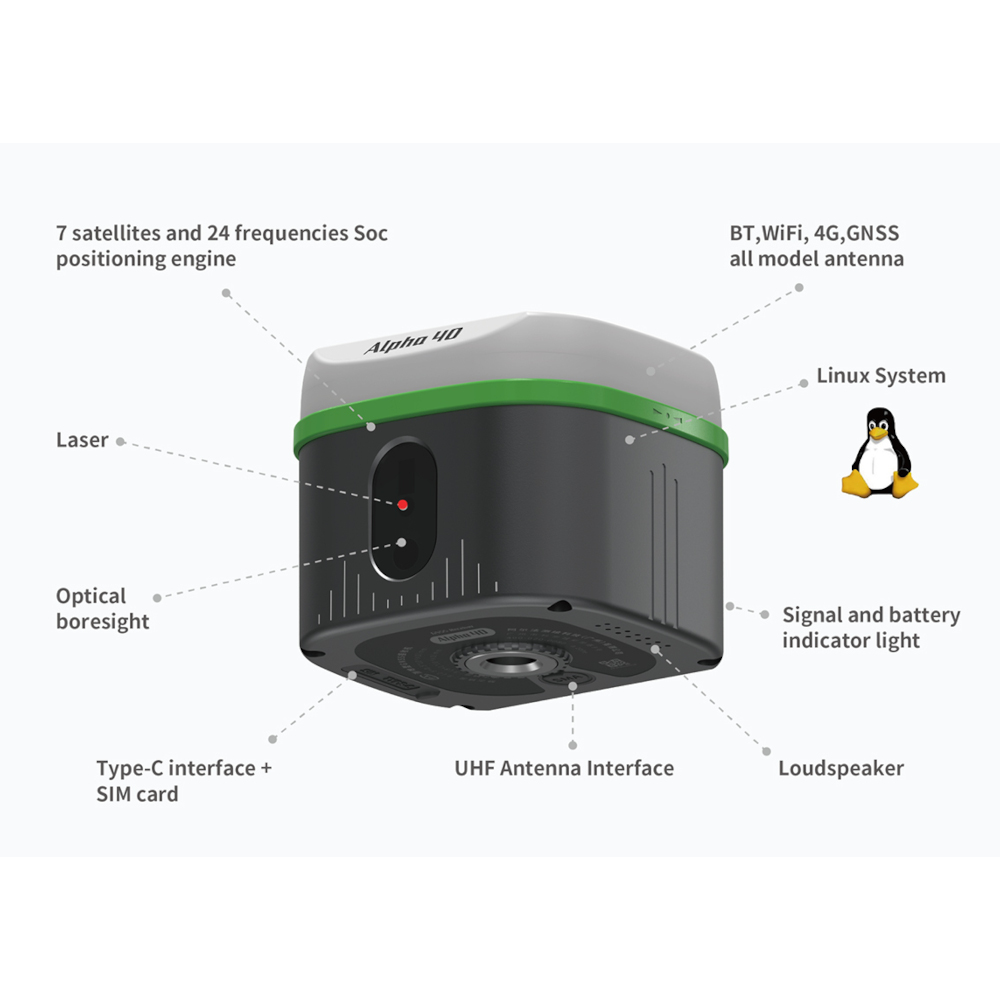


Alpha 40 GNSS RTK Receiver with Laser IMU and AR Camera
Get the best price for your setup
Contact our experts for the best possible price and configuration.
- Fast response
- Expert configuration advice
- No overpaying for features you do not need
The Alpha 40 GNSS RTK is a compact survey-grade RTK receiver built for fast and flexible field measurement. It combines multi-constellation GNSS, laser measurement, IMU tilt compensation and AR-guided stakeout to help surveyors, construction crews, engineers, GIS teams and drone mapping users measure points that are difficult, unsafe or impractical to reach with a pole.
With its lightweight 650 g body, 4G connectivity, built-in UHF/LoRa radio and DiMap Pro field software support, the Alpha 40 is suited for daily topographic surveys, construction layout, CAD mapping, road work, earthworks, photovoltaic layout, power line surveys and drone base station workflows.
Alpha 40 GNSS RTK Highlights
| Laser Measurement | Up to 50 m range with ±1 mm laser ranging accuracy |
|---|---|
| IMU Tilt Compensation | 0° to 60° tilt range with calibration-free operation |
| AR Stakeout | Dual AR camera guidance for far and near point finding |
| GNSS Tracking | 1408 channels with GPS, BDS, GLONASS, Galileo, QZSS, SBAS and NavIC |
| Connectivity | 4G, WiFi, Bluetooth 5.2, Type-C and 2W UHF/LoRa radio |


Valued customers:








Find RTK Networks
Search NTRIP providers and connect to reliable RTK correction services.
Description
Alpha 40 GNSS RTK Receiver for Laser Surveying and AR Stakeout
The Alpha 40 GNSS RTK is a modern optic-electric RTK receiver designed for surveyors, construction professionals, engineers, GIS field teams and drone pilots who need accurate positioning in real working conditions. It brings GNSS positioning, laser measurement, IMU tilt compensation and AR camera guidance together in one compact receiver, making it a practical tool for both everyday site work and more complex measurement tasks.
In the field, not every point is easy to reach with a survey pole. Corners behind fences, road edges, building façades, ditches, slopes, manholes, overhead or underground points and unsafe areas can slow down a normal RTK workflow. The Alpha 40 helps solve this by using laser-assisted measurement and optical calibration, so users can capture selected points without always placing the pole directly on the target.
Laser Measurement for Inaccessible Points
The Alpha 40 uses an integrated laser measurement system to support non-contact point measurement. This is useful when measuring hidden points, building edges, traffic areas, trenches, water edges or locations where standing directly on the point is not practical. For construction workers and surveyors, this can reduce setup time and improve safety when working around obstacles or busy sites.
The receiver combines laser ranging with GNSS and inertial measurement data. In practical terms, this means the user can aim at the target, measure the offset and still record usable RTK position data for the job. This is especially valuable for detail surveys, cadastral support work, as-built checks and site measurements where speed and flexibility matter.
IMU Tilt Compensation for Faster Pole Work
With calibration-free IMU tilt compensation, the Alpha 40 allows users to measure while the pole is tilted. This helps when working near walls, under trees, beside vehicles, on slopes or around site obstacles where keeping the pole perfectly vertical is difficult. Instead of stopping to level the pole for every point, the user can keep moving and still collect accurate data within the supported tilt range.
For construction layout and general surveying, tilt compensation makes the workflow more forgiving. It is also useful for less experienced field crews because it reduces the need for perfect pole handling on every observation.
AR Guided Stakeout for Clearer Layout Work
The Alpha 40 supports AR-guided stakeout using camera-based visual guidance. Instead of relying only on arrows, distances and numbers on the controller screen, the user can see the design point overlaid on the real site view. This makes stakeout easier to understand, especially for construction teams, layout crews and operators who need to find points quickly on busy or visually complex sites.
The receiver supports both remote and near-view AR stakeout guidance. This helps the user move toward the point from a distance and then switch to a closer visual view when approaching the final position. For site layout, road work, photovoltaic projects and earthworks, this can make point finding faster and more intuitive.
Multi Constellation GNSS Performance
The Alpha 40 tracks multiple satellite constellations including GPS, BDS, GLONASS, Galileo, QZSS, SBAS and NavIC. Its 1408-channel GNSS board is designed to support reliable RTK positioning in a wide range of environments. For field users, this means better satellite availability when working in open areas, semi-obstructed sites or locations where satellite geometry changes during the day.
The receiver is suitable for RTK rover work, base-rover workflows and correction service use through NTRIP. It can be used for point measurement, control point checks, topographic work, CAD mapping, road stakeout, power survey work, tower base layout, photovoltaic stakeout, surface measurements and earthwork calculations.
Built for Surveying, Construction, GIS and Drone Work
The Alpha 40 is not only aimed at traditional surveyors. It is also useful for construction companies that need accurate layout, drone pilots who need a reliable RTK base station, GIS teams collecting accurate asset data, and engineers working on infrastructure, roads, utilities, solar parks and land development projects.
For drone mapping, the Alpha 40 can work as a base station and supports integration workflows for unmanned systems. For GIS users, the combination of RTK accuracy, mobile connectivity and field software makes it suitable for collecting asset positions, boundaries, inspection points and site features with higher confidence than standard handheld GPS devices.
Field Software and Controller Workflow
The Alpha 40 works with DiMap Pro field software for common surveying and layout tasks. The software supports point survey, detail survey, control point measurement, point stakeout, CAD mapping, road design stakeout, line and surface measurement, curve stakeout, tower base stakeout, photovoltaic stakeout and earthwork measurement.
For users working with CAD drawings, DiMap Pro supports large files, multiple layers, map backgrounds, WMS configuration, file sharing, measurement correction tools and field calculation functions. This gives surveyors and construction teams a complete workflow from measurement to layout without constantly switching between different tools.
Connectivity for Real Site Conditions
The Alpha 40 includes 4G, WiFi, Bluetooth and Type-C connectivity, giving field crews several ways to connect the receiver, controller and correction services. The built-in 2W UHF radio and LoRa support make it suitable for base-rover setups, while the external radio interface gives more flexibility for projects that need longer communication range or specific site configurations.
This makes the receiver practical for contractors and survey teams who move between different job types, from small construction sites to larger infrastructure and mapping projects.
Compact and Rugged Design
At around 650 g, the Alpha 40 is light enough for long days on the pole while still offering the features expected from a professional RTK receiver. The IP67-rated housing helps protect the receiver against dust and water, and the working temperature range supports use in demanding outdoor environments.
The receiver is designed for real fieldwork, with clear indicator lights, intelligent voice prompts, a Type-C port for charging and data transfer, and a long working time depending on the selected communication mode. For crews working full days outdoors, this helps reduce downtime and keeps the workflow simple.
Who Should Use the Alpha 40 GNSS RTK?
The Alpha 40 is a strong choice for users who need more than a basic RTK rover. It is especially useful for professionals who regularly measure hard-to-reach points, perform stakeout work, use CAD drawings in the field or need a compact receiver that can serve survey, construction, GIS and drone workflows.
Typical users include land surveyors, construction layout teams, civil engineers, road contractors, solar farm installers, utility mapping teams, GIS data collectors, drone mapping companies and machine control support teams. For buyers comparing RTK GNSS equipment, the Alpha 40 stands out because it combines laser measurement, AR visual guidance and tilt compensation in a compact field-ready receiver.
Buying from Global GPS Systems
Global GPS Systems supplies professional GNSS, surveying and construction measurement equipment for users who need reliable tools and practical support. When buying the Alpha 40 GNSS RTK from Global GPS Systems, customers can get help choosing the right setup for their workflow, whether they need a rover, a base-rover solution, correction service compatibility, drone base station use or a complete field surveying package.
Datasheets & Manuals
Specifications
Alpha 40 GNSS RTK Specifications
Product Overview
| Product Name | Alpha 40 GNSS RTK |
|---|---|
| Product Type | Optic-electric RTK GNSS receiver |
| Primary Applications | Surveying, drone base station workflows, RTK positioning, construction layout, mapping, staking-out, hidden point measurement, inaccessible point measurement and unmanned system positioning fusion |
| Core Technologies | GNSS RTK, laser measurement, optical calibration, AR dual-camera guidance, inertial navigation and dual-mode radio communication |
| Receiver Channels | 1408 channels |
| Operating System | Linux |
| Memory | 32 GB |
| Data Recording Formats | DAT, RINEX |
GNSS Signal Tracking
| GPS | L1C/A, L1C, L2C, L2P, L5 |
|---|---|
| BeiDou / BDS | B1I, B2I, B3I, B1C, B2a, B2b |
| GLONASS | G1, G2, G3 |
| Galileo | E1, E5a, E5b, E6 |
| QZSS | L1C/A, L1C, L2C, L5 |
| SBAS | L1 |
| NavIC | L5 |
Positioning Accuracy
| Static Accuracy - Horizontal | ±(2.5 + 0.5 × 10⁻⁶D) mm |
|---|---|
| Static Accuracy - Vertical | ±(5 + 0.5 × 10⁻⁶D) mm |
| RTK Accuracy - Horizontal | ±(8 + 1 × 10⁻⁶D) mm |
| RTK Accuracy - Vertical | ±(15 + 1 × 10⁻⁶D) mm |
| Update Rate | 200 Hz |
Tilt Compensation and Inertial Navigation
| IMU / INS Accuracy | 0.015° inertial navigation accuracy |
|---|---|
| Tilt Compensation Accuracy | ±(8 + 0.3 × TILT) mm |
| Compensation Angle | 0° to 60° |
| Tilt Measurement at 60° | 2 cm accuracy at 60° inclination |
| Initialization | No initialization required; enters inertial navigation mode after walking a few steps |
| Sensor Fusion | GNSS, INS, positioning data, magnetometer data, temperature compensation algorithms and laser ranging |
Laser Measurement and Optical System
| Laser Measurement Range | 50 m |
|---|---|
| Laser Measurement Accuracy | ±1 mm |
| Non-Contact Measurement Accuracy | 3 cm to 5 cm at 10 m distance |
| Measurement Capability | 360° non-contact measurement |
| Optical Calibration | Synchronizes the crosshair aiming point with the actual laser measurement target for visible positioning even when the laser spot is difficult to see under strong sunlight |
| Typical Laser Measurement Scenarios | Cadastral hidden points, aerial points, underground points and inaccessible points |
AR Staking-Out and Camera Functions
| AR Guidance | Dual AR staking-out guidance |
|---|---|
| Remote AR Staking-Out | Supported |
| Proximal AR Staking-Out | Supported |
| Near-View AR Switching Distance | Approximately 5 m; adjustable |
| Real-Scene Point Finding Accuracy | 1 cm |
| Outdoor Display Support | 360° real-time clear display under strong outdoor light |
| Camera / Version Options | Laser with one-camera version; laser with dual-camera version |
Radio Communication
| Integrated Radio | Built-in 2 W radio |
|---|---|
| Radio Type | Dual-mode transceiver with full-power compatible radio and LoRa low-power long-range transceiver |
| Frequency Range | 410 MHz to 470 MHz |
| Operation Mode | Transceiver |
| Global Communication Protocols | TRIMTALK 450S, TRIMMARK III, SOUTH9600, SOUTH19200, SATEL9600, SATEL19200, Transparent, LoRa |
| External Radio Support | Serial port supports connection to external high-power radios |
| UHF Antenna Interface | SMA radio UHF antenna interface |
| Recommended Base Setup | Set the base station in a relatively high and open area for best radio performance |
Wireless and Network Connectivity
| Cellular Network | 4G |
|---|---|
| Wi-Fi | 802.11 a/b/g/n/ac |
| Bluetooth | Bluetooth 5.2 BR/EDR + LE dual-mode Bluetooth |
| Web Interface | WebUI supported |
| PPP | Supported |
| 4G Card Slot | Supported |
| Onboard 4G | Supported |
Ports, Indicators and Audio
| Type-C Interface | Charging, data transmission and external port connection |
|---|---|
| SMA Port | Radio UHF antenna connection |
| Indicator Lights | Satellite, datalink, Bluetooth and battery lights |
| Battery Level Display | Supported |
| Loudspeaker | Supported |
| Voice Prompts | Intelligent voice supported |
Power and Battery
| Input Voltage | 9 V to 20 V power delivery |
|---|---|
| Battery Capacity | 37 Wh |
| Working Time - NTRIP | Up to 18 hours |
| Working Time - Radio Receiving | Up to 15 hours |
| Working Time - Radio Transmitting | Up to 8 hours |
| Charging Interface | USB Type-C |
| Long Battery Life | Supported |
Physical Specifications
| Dimensions | 100 mm × 100 mm × 80 mm, excluding 5/8-inch pin interface |
|---|---|
| Weight | 650 g |
| Housing Material | Aluminum-magnesium alloy housing |
| Cover | Nano wave-transparent cover |
| Internal Frame | Shielding middle frame |
| Antenna Integration | Bluetooth, Wi-Fi, 4G and GNSS full-mode antenna |
| Pole Configuration | 1.8 m lightweight carbon fiber portable pole |
| Retracted Pole Length | 75 cm |
| Instrument Box Configuration | 22 cm high instrument box configuration |
Environmental and Durability
| Operating Temperature | -30°C to +70°C |
|---|---|
| Storage Temperature | -40°C to +80°C |
| Water and Dust Protection | IP67 |
| Shock Resistance | 1.8 m drop resistance on hard ground at normal temperature |
| Humidity | Up to 100% |
Field Software
| Software | DiMap Pro professional field software |
|---|---|
| Survey Functions | Point measurement, detailed measurement, control point measurement, point stakeout, CAD mapping, road design stakeout, power survey and elevation site control |
| Advanced Measurement Functions | Line measurement, surface measurement, curve stakeout, tower base stakeout, photovoltaic stakeout and earthwork measurement |
| CAD Engine | Supports smooth opening and running of files over 100 MB, loading more layers and complete drawing functions |
| Text and Format Support | Multiple text encoding formats, custom data decimal places and multiple angle formats |
| Map Support | Amap standard map, Amap satellite map, OpenStreetMap, WMS map configuration and map calibration |
| Data Sharing | Cloud sharing and file sharing supported |
| Workflow Tools | Shortcut key customization, survey area import range preview, bias correction, background layer setting, tilt measurement accuracy check, function customization, post-measurement correction and built-in calculator |
Controller Specifications
| Controller | Alpha Controller |
|---|---|
| Display | 5.5-inch large screen |
| Processor | 8-core processor |
| Memory and Storage | 4 GB RAM + 64 GB storage |
| Ingress Protection | IP67 |
| Touchscreen | 10-point touch |
| Rainy Mode | Supported |
| Glove Mode | Supported |
Drone Base Station and Integration
| Drone Base Station Function | Supported |
|---|---|
| Serial Port Customization | Supported |
| Unmanned System Integration | Supports positioning fusion for unmanned systems and laser radar workflows |
| Compatible Workflow Types | Smart terminals, optoelectronic products and unmanned systems |
Version Options
| Version | Camera Configuration | Notes |
|---|---|---|
| Laser with One-Camera | Single-camera laser configuration | Version shown in datasheet |
| Laser with Dual-Camera | Dual-camera laser configuration | Supports AR dual-camera workflow where configured |
Professional Set Package Contents
| Item | Quantity | Notes |
|---|---|---|
| Alpha 40 Receiver | 1 | Main GNSS RTK receiver |
| Radio Antenna | 1 | For UHF radio communication |
| Host Adapter | 1 | Receiver power/accessory adapter |
| Host Cable | 1 | Receiver cable |
| Controller | 1 | Alpha Controller |
| Controller Adapter | 1 | Controller power/accessory adapter |
| Controller Cable | 1 | Controller cable |
| Centering Pole | 1 | Survey pole |
| Bracket | 1 | Mounting bracket |
| Instruction | 1 | Instruction document/manual |
| Carrying Case | 1 | Transport case |
Specifications and package contents may vary by configuration, region or manufacturer update. Always check the current configuration before ordering.
Reviews (0)
Only logged in customers who have purchased this product may leave a review.
FAQ
Alpha 40 GNSS RTK FAQ
Product Overview
What is the Alpha 40 GNSS RTK?
The Alpha 40 GNSS RTK is a professional optic-electric RTK GNSS receiver designed for accurate surveying, construction layout, drone mapping, positioning, and field measurement. It combines GNSS RTK positioning, laser measurement, optical calibration, inertial navigation, AR stakeout, and flexible communication options in one compact receiver.
Who is the Alpha 40 GNSS RTK designed for?
The Alpha 40 is designed for land surveyors, construction professionals, engineers, drone mapping teams, GIS and mapping specialists, utility mapping teams, infrastructure contractors, and other professionals who need accurate field positioning and efficient stakeout workflows.
What makes the Alpha 40 different from a standard RTK GNSS receiver?
The Alpha 40 adds laser measurement, optical calibration, dual AR stakeout, advanced inertial navigation, and dual-mode radio communication to standard RTK GNSS positioning. This makes it suitable for both conventional pole-based measurement and non-contact measurement of hard-to-reach points.
Can the Alpha 40 be used for drone mapping?
Yes. The Alpha 40 supports drone base station workflows and can be used for accurate positioning in drone mapping, aerial surveying, and unmanned system applications. It also supports serial port customization for integration with unmanned systems and related positioning workflows.
Is the Alpha 40 suitable for construction layout?
Yes. The Alpha 40 is suitable for construction layout, point stakeout, road work, CAD-based field layout, earthwork measurement, and infrastructure projects. Its AR stakeout and IMU tilt compensation can help field crews locate and measure points more efficiently on site.
Accuracy, IMU and Laser Measurement
What RTK accuracy does the Alpha 40 provide?
The Alpha 40 supports survey-grade RTK positioning with horizontal RTK accuracy of ±(8 + 1×10⁻⁶D) mm and vertical RTK accuracy of ±(15 + 1×10⁻⁶D) mm under suitable conditions. Actual field accuracy depends on satellite visibility, correction quality, environment, setup, and workflow.
What is the tilt compensation range of the Alpha 40?
The Alpha 40 supports IMU tilt compensation from 0° to 60° with a 200 Hz update rate. This allows users to measure points without keeping the pole perfectly level, which is useful near obstacles, walls, trenches, fences, and difficult terrain.
Does the Alpha 40 require IMU initialization?
The Alpha 40 is designed for fast inertial navigation operation. It can enter inertial navigation mode after walking a few steps, helping reduce setup time and making field measurement faster during everyday surveying tasks.
What is the laser measurement range of the Alpha 40?
The Alpha 40 has a laser measurement range of up to 50 m with laser accuracy of ±1 mm. Laser measurement is useful for points that are difficult, unsafe, or impossible to access directly with a survey pole.
Can the Alpha 40 measure hard-to-reach points?
Yes. The Alpha 40 can measure inaccessible or difficult points using a combination of GNSS RTK positioning, IMU data, optical calibration, and laser ranging. This is useful for hidden points, aerial points, underground points, and points across obstacles or unsafe areas.
What is optical calibration used for?
Optical calibration synchronizes the aiming crosshair with the actual laser measurement target. This helps improve measurement reliability and visibility, including in bright sunlight where a laser spot may be difficult to see.
GNSS, RTK Corrections and Connectivity
Which satellite systems does the Alpha 40 support?
The Alpha 40 supports multiple GNSS constellations and signals, including GPS, BeiDou, GLONASS, Galileo, QZSS, SBAS, and NavIC. Multi-constellation tracking helps improve availability and reliability in professional field positioning workflows.
How many GNSS channels does the Alpha 40 have?
The Alpha 40 has 1408 GNSS channels. This allows the receiver to track many satellite signals across supported constellations for accurate RTK positioning and reliable field performance.
Can the Alpha 40 use RTK network or NTRIP corrections?
Yes. The Alpha 40 can be used with RTK correction services such as NTRIP networks when compatible correction data and mobile internet are available. This is suitable for rover-only workflows where a local base station is not required.
Can the Alpha 40 work with a local base station?
Yes. The Alpha 40 can be used in rover-base workflows where correction data is sent from a local base station to the rover. This is useful in remote areas, private construction sites, or locations without reliable RTK network coverage.
Does the Alpha 40 have a built-in radio?
Yes. The Alpha 40 includes a built-in 2W UHF radio and LoRa low-power long-range dual-mode communication. It supports the 410–470 MHz frequency range and mainstream RTK communication protocols.
What connectivity options does the Alpha 40 support?
The Alpha 40 supports 4G, WiFi, Bluetooth 5.2, Type-C connection, GNSS communication, and UHF radio communication. These options allow the receiver to support different RTK correction, data transfer, controller, and field workflow requirements.
Field Workflow, Software and Hardware
What is dual AR stakeout on the Alpha 40?
Dual AR stakeout uses real-scene visual guidance to help users find and stake out points in the field. The system can switch between far-view and near-view AR guidance, making it easier to navigate to the correct point during layout work.
What software can be used with the Alpha 40?
The Alpha 40 works with professional field software such as DiMap Pro. The software supports tasks such as point measurement, detailed measurement, control point measurement, point stakeout, CAD mapping, road design stakeout, line measurement, surface measurement, curve stakeout, and earthwork measurement.
Can the Alpha 40 handle CAD-based field work?
Yes. When used with compatible field software, the Alpha 40 can support CAD mapping and CAD-based stakeout workflows. This is useful for construction layout, road projects, infrastructure work, and survey teams working from design files.
How portable is the Alpha 40?
The Alpha 40 receiver is compact and lightweight, with receiver dimensions of approximately 100 mm × 100 mm × 80 mm and a weight of about 650 g. This makes it practical for daily field use, drone mapping support, and mobile surveying workflows.
What is the environmental protection rating of the Alpha 40?
The Alpha 40 has an IP67 water and dust protection rating. It is designed for professional outdoor use and can operate in temperatures from -30°C to +70°C, making it suitable for demanding field environments.
What is included in the Alpha 40 professional set?
The professional set can include the Alpha 40 receiver, radio antenna, host adapter, host cable, controller, controller adapter, controller cable, centering pole, bracket, instruction materials, and carrying case. Exact package contents may depend on the selected configuration.
 GPS & GNSS
 Total Stations
 Data collectors
 Software
 Correction services
 Machine control
 External radio
 Marine
 Accessories
Reviews
There are no reviews yet