
 GPS & GNSS
 Lidar scanning
 Total Station
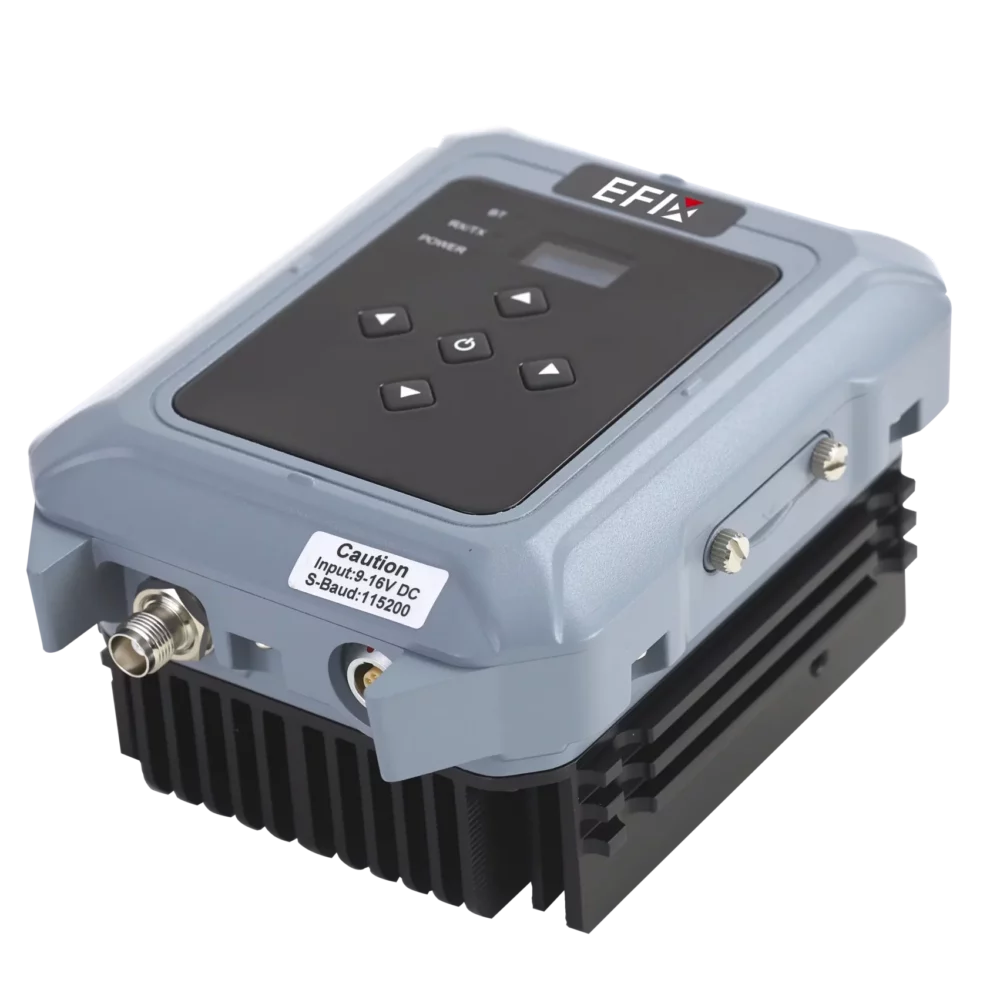
EFIX FL3 UHF RTK Datalink Radio Modem
This product is Available
Contact our experts for the best possible price and configuration.
The EFIX FL3 is a rugged UHF RTK datalink radio modem for sending GNSS correction data from a base station to one or more rovers. With 410 MHz to 470 MHz operation, adjustable transmit power up to 28 W and an IP67 metal housing, it is built for survey, construction, mapping and field engineering teams that need a dependable radio link where mobile internet or NTRIP coverage is not always available.
EFIX FL3 Highlights
| Radio Frequency | 410 MHz to 470 MHz UHF |
|---|---|
| RTK Transmission Range | Up to 30 km or more in good conditions |
| Transmit Power | Adjustable 5 W / 22 W / 28 W |
| Field Protection | IP67 dustproof and waterproof metal housing |
| Operation Modes | Transceiver, transmit only, receive only and radio repeater |


Valued customers:










Find RTK Networks
Search NTRIP providers and connect to reliable RTK correction services.
Description
Reliable RTK radio communication for GNSS fieldwork
The EFIX FL3 is an external UHF radio modem designed to transmit RTK GNSS correction data between a base station and rover receivers. It is a practical choice for surveyors, construction crews, GIS teams, drone mapping operators and engineering companies working in areas where an independent radio link is preferred over mobile data.
In the field, a stable correction link is just as important as the GNSS receiver itself. The FL3 helps a base station send correction data across a project site so rovers can keep working with accurate RTK positions. This is especially useful for road construction, earthworks, land surveying, utilities, agriculture, open-pit sites and remote mapping jobs where cellular coverage can be weak or inconsistent.
Long-distance UHF correction transmission
The EFIX FL3 operates in the 410 MHz to 470 MHz UHF frequency range and is built for base-to-rover RTK communication. Under good field conditions, it can provide correction transmission over distances of up to 30 km or more, allowing one base setup to support a wider working area and, in many cases, multiple rover users.
For survey teams, this means fewer base relocations and a more efficient workflow across larger sites. For construction and machine control support teams, it helps keep crews connected to the same correction source while working across open fields, infrastructure corridors or large job sites.
Adjustable power for different site conditions
The FL3 offers adjustable transmit power up to 28 W. Lower power settings can be used when the rover is working close to the base, while higher power settings are useful for longer distances or more difficult radio environments. This flexibility helps balance communication range, power use and site requirements.
The radio supports common RTK datalink protocols including CHC, Transparent and TT450S, making it easier to integrate into different GNSS base and rover setups. It also supports selectable wireless link rates, so the radio can be configured to suit the correction format and project workflow.
Built for outdoor survey and construction sites
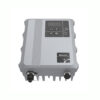
The EFIX FL3 has a robust metal housing with IP67 dust and water protection. This makes it suitable for daily outdoor use on construction sites, survey tripods, base station setups and temporary project installations. The housing also includes heat dissipation features to support stable operation during longer working sessions.
The unit uses a 5-pin LEMO port for external power and data transmission, a TNC antenna connection and an RS232 serial interface. These are familiar connection types for professional GNSS and survey equipment, making the FL3 a straightforward addition to many existing RTK base station kits.
Simple control in the field
The front panel includes a display, status indicators and control buttons for quick configuration. Operators can select channels, change data protocol, adjust link rate, set transmit power and check device status without needing a complicated setup process. This is helpful for crews that need to get a base station running quickly before starting measurements, stakeout or machine control support work.
The FL3 can work as a transceiver, transmit-only radio, receive-only radio or radio repeater. Repeater mode can be useful when a direct base-to-rover radio path is difficult due to distance, terrain or site obstructions. As with all UHF equipment, frequency and power use should always follow local radio regulations.
Who uses the EFIX FL3?
The EFIX FL3 is mainly used by professionals who need dependable RTK correction transmission in the field. Land surveyors can use it for topographic surveys, boundary work and stakeout. Construction teams can use it to support GNSS rovers on earthworks, road projects and site preparation. GIS and mapping crews can use it when collecting accurate field data away from reliable mobile networks. Drone mapping teams can also use a radio-based base setup when ground control and GNSS correction workflows require a local RTK link.
For buyers comparing GNSS radio equipment, the FL3 is best understood as a rugged external datalink for projects where range, stable correction delivery and practical field setup matter more than extra software features.
Buying from Global GPS Systems
Global GPS Systems supplies professional GNSS equipment for survey, construction, mapping, drone and GIS users worldwide. When adding the EFIX FL3 to a GNSS workflow, the team can help check compatibility with your receiver setup, antenna, cables and correction method so the radio is configured for the way your crew actually works in the field.
Datasheets & Manuals
Datasheets and manuals
Datasheet
Specifications
EFIX FL3 Specifications
Product Overview
| Product Name | EFIX FL3 |
|---|---|
| Product Type | External UHF radio modem / GNSS RTK datalink |
| Primary Application | Base-to-rover RTK GNSS correction data transmission |
| Typical Users | Surveying, geospatial, construction, mapping and GNSS field professionals |
| Transmission Range | Up to 30 km radius or more in good conditions |
| Housing | Rugged metal housing with enhanced heat radiator |
Radio Specifications
| Frequency Band | 410 MHz to 470 MHz |
|---|---|
| Frequency Step Value | 25 kHz / 12.5 kHz |
| Channel Number | Supports up to 200 editable channels |
| Work Modes | Transceiver, transmit only, receive only, radio repeater |
| Supported Protocols | EFIX, Transparent, TT450S; datasheet also lists CHC |
| Modulation | GMSK / 4FSK |
| Frequency Stability | < ±1 ppm |
| Preset Channels | Supported |
Transmit Power and Power Consumption
| Mode / Power Level | Transmit Power | Typical Power Consumption |
|---|---|---|
| High Power | 28 W | 72 W @ 12 V DC |
| High Power | 25 W | 66 W @ 12 V DC |
| High Power | 22 W | 60 W @ 12 V DC |
| Low Power | 15 W | 54 W @ 12 V DC |
| Low Power | 10 W | 44 W @ 12 V DC |
| Low Power | 5 W | 35 W @ 12 V DC |
| Standby | Not applicable | 2 W @ 12 V DC |
Transmitter Performance
| Frequency Range / Mode | Power Level | RF Output Power |
|---|---|---|
| 410 MHz to 440 MHz | High power above 20 W | ≥43.0 dBm @ 12 V DC |
| 410 MHz to 440 MHz | Low power above 5 W | ≥37 dBm @ 12 V DC |
| 440 MHz to 470 MHz | 28 W | 44.5 ±0.5 dBm @ 12 V DC |
| 440 MHz to 470 MHz | 25 W | 44 ±0.5 dBm @ 12 V DC |
| 440 MHz to 470 MHz | 22 W | 43.4 ±0.5 dBm @ 12 V DC |
| 440 MHz to 470 MHz | 15 W | 42 ±0.5 dBm @ 12 V DC |
| 440 MHz to 470 MHz | 10 W | 40 ±1 dBm @ 12 V DC |
| 440 MHz to 470 MHz | 5 W | 37 ±1 dBm @ 12 V DC |
| RF Power Stability | All modes | ±1 dB |
| Adjacent Channel Power | All modes | >50 dB |
Receiver Performance
| Sensitivity | Better than -114 dBm @ BER 10-3, 9600 bps |
|---|---|
| Co-channel Suppression | >-12 dB |
Modem and Data Communication
| Air / Wireless Link Baud Rate | 4800 bps / 9600 bps / 19200 bps |
|---|---|
| Serial Port Baud Rate | 9600, 19200, 38400, 57600, 115200 bps |
| Serial Communication | RS232 serial port, up to 115200 bps |
| Serial Port Baud Rate Adaptive Function | Supported |
| Data Protocol Selection | Selectable from device menu |
| Communication Parameters for Configuration | 8 data bits, 1 stop bit, no parity, no data flow control |
Interfaces and Ports
| Data Interface | LEMO 5-pin |
|---|---|
| Power and Data Port | 1 x 5-pin LEMO port for external power and data transmit |
| Antenna Interface | TNC female connector |
| Antenna Interface Impedance | 50 ohm |
| RF Interface | 50 ohm, TNC female connector |
| Serial Port Pin 1 | Power supply, 9 V to 16 V DC |
| Serial Port Pin 2 | Power GND |
| Serial Port Pin 3 | Serial port data receiving, RXD |
| Serial Port Pin 4 | Serial port signal ground |
| Serial Port Pin 5 | Serial port data transmitting, TXD |
User Interface and Controls
| Display | 1 x LCD / OLED display |
|---|---|
| LED Indicators | 3 x two-color LED indicators |
| RX/TX Indicator | Green for receiving, red for transmitting |
| Power Indicator | Green for normal power, red for underpowered |
| Bluetooth Indicator | Indicates Bluetooth pairing status |
| Control Buttons | 5 function buttons / 6 listed controls: power on/off, enter, up, down, left, right |
| Power-On Operation | Press and hold power button for 3 to 5 seconds |
| Menu Navigation | Left/right buttons switch menus; up/down buttons select menu items; enter confirms |
| Supported Display Languages | Chinese and English |
| Device Status Display | Displays device model, firmware version, hardware version and serial number information |
Power
| External Power Input | 9 V DC to 16 V DC |
|---|---|
| Operating Voltage | 9 V to 16 V |
| Normal Voltage Indicator | Green power indicator remains on from 9.5 V to 16 V |
| Low Voltage Warning | Red power indicator flashes twice per second when voltage is less than 9.5 V |
| Automatic Power Recovery | Automatically turns on when reconnected to power after accidental shutdown |
Physical and Environmental
| Dimensions | 175 x 130 x 86.5 mm according to user guide; datasheet lists 175 x 140 x 65 mm |
|---|---|
| Weight | 2 kg / 70.5 oz |
| Ingress Protection | IP67 dustproof and waterproof |
| Water Protection Detail | Protected from temporary immersion to a depth of 1 m |
| Operating Temperature | -40°C to +65°C |
| Storage Temperature | -50°C to +85°C |
| Mount | Tripod bracket |
| Housing Material / Design | Robust metal housing |
| Thermal Design | Enhanced heat radiator |
Factory Default Parameters
| Default Serial Port Baud Rate | 115200 bps |
|---|---|
| Default Protocol | EFIX |
| Default Air Baud Rate | 9600 bps |
| Default RF Output Power | High Power 22 W, 43.4 ±0.5 dBm @ 12 V DC |
| Default Channel | CH7 |
Included Items
| Item | Quantity | Notes |
|---|---|---|
| EFIX FL3 External Radio | 1 | Main UHF radio modem unit |
| Other Accessories | Not specified | Package contents were not listed in the available product page, datasheet or user guide |
Regulatory and Use Notes
| UHF Radio Use | Use of UHF datalink may be subject to local regulations and frequency/power permissions |
|---|---|
| Operating Requirement | Device should only be operated on permitted frequencies and power outputs according to local authority requirements |
Specifications and package contents may vary by configuration, region or manufacturer update. Always check the current configuration before ordering.
FAQ
EFIX FL3 FAQ
Product Overview
What is the EFIX FL3?
The EFIX FL3 is an external UHF radio modem designed for GNSS RTK datalink communication. It transmits correction data from a GNSS base station to one or more rover receivers, helping field crews maintain accurate RTK positioning.
What is the EFIX FL3 used for?
The EFIX FL3 is used to send RTK correction data between a GNSS base and rover in surveying, construction layout, mapping, geospatial measurement, and other precision positioning applications.
Is the EFIX FL3 a GNSS receiver?
No. The EFIX FL3 is not a GNSS receiver. It is an external UHF radio datalink that works with compatible GNSS base and rover systems to transmit RTK corrections.
Who is the EFIX FL3 designed for?
The EFIX FL3 is designed for professional surveyors, construction teams, geospatial professionals, civil engineering crews, and GNSS users who need reliable base-to-rover RTK correction transmission in the field.
Why use an external radio for RTK corrections?
An external radio can provide a strong and stable correction link when mobile internet, NTRIP access, or internal GNSS radio range is limited. It is especially useful for remote sites, large open areas, and projects where a local base station is preferred.
Can one base station support multiple rovers with the EFIX FL3?
Yes. The EFIX FL3 is designed to help maximize the coverage of a single GNSS base station so correction data can be transmitted to multiple rover receivers within the working area, depending on setup and site conditions.
Range and RTK Performance
What is the transmission range of the EFIX FL3?
The EFIX FL3 can transmit RTK corrections up to 30 km or more in good conditions. Actual range depends on terrain, antenna setup, interference, frequency settings, transmit power, and line of sight between the base and rover.
What frequency range does the EFIX FL3 use?
The EFIX FL3 operates in the 410 MHz to 470 MHz UHF frequency range, which is commonly used for GNSS surveying radio communication.
What transmit power settings are available?
The EFIX FL3 supports adjustable transmit power settings of 5 W, 22 W, and 28 W. This allows users to adapt the radio output to the required range, field conditions, and local radio regulations.
When should I use a higher transmit power setting?
A higher transmit power setting can help improve correction transmission over longer distances or more difficult environments. Users should always follow local frequency and power regulations before operating the radio.
Does the EFIX FL3 work in open fields and urban areas?
Yes. The EFIX FL3 is designed for RTK correction transmission in both open fields and urban areas. Performance will vary depending on obstacles, radio interference, antenna height, and site layout.
What can affect the EFIX FL3 radio signal?
Signal performance can be affected by terrain, buildings, trees, antenna height, cable quality, interference from other radio systems, incorrect frequency settings, and the distance between the base and rover.
Compatibility and Setup
What communication interface does the EFIX FL3 use?
The EFIX FL3 includes an RS232 serial port with communication up to 115,200 bps, allowing it to transmit correction data from compatible GNSS equipment.
What link rates does the EFIX FL3 support?
The EFIX FL3 supports 4,800 bps, 9,600 bps, and 19,200 bps link rates, giving users flexibility when configuring the datalink for different GNSS correction workflows.
Which protocols are supported by the EFIX FL3?
The EFIX FL3 supports CHC, Transparent, and TT450S protocols. Compatibility should always be checked with the GNSS base station and rover before use.
What modulation types does the EFIX FL3 use?
The EFIX FL3 supports GMSK and 4FSK modulation for UHF correction data transmission.
What ports and connectors are included?
The EFIX FL3 includes a 5-pin LEMO port for external power and data transmission, plus a TNC port for the external antenna connection.
What power supply does the EFIX FL3 need?
The EFIX FL3 requires an external power supply from 9 V DC to 16 V DC.
Is the EFIX FL3 easy to configure in the field?
Yes. The EFIX FL3 has an LCD display, LED indicators, function buttons, and preset frequency channel support, making field configuration and monitoring straightforward for trained users.
Durability, Installation and Regulations
Is the EFIX FL3 waterproof and dustproof?
Yes. The EFIX FL3 has an IP67 rating, meaning it is protected against dust and temporary immersion in water up to 1 meter under specified conditions.
Is the EFIX FL3 suitable for harsh field environments?
Yes. The EFIX FL3 is built with a rugged industrial design, robust metal housing, enhanced heat radiator, and IP67 protection, making it suitable for demanding surveying and construction environments.
How large and heavy is the EFIX FL3?
The EFIX FL3 measures 175 mm x 140 mm x 65 mm and weighs approximately 2 kg, making it suitable for tripod-mounted field use.
How is the EFIX FL3 mounted?
The EFIX FL3 is designed for use with a tripod bracket, allowing the radio to be positioned effectively at a GNSS base station setup.
Do I need permission or a license to use the EFIX FL3?
UHF radio use may be subject to local regulations. Users should check local frequency and transmit power rules and obtain any required permissions before operating the EFIX FL3.
How can I get the best performance from the EFIX FL3?
For best performance, use the correct frequency and protocol settings, position the antenna as high and clear as possible, use suitable cables and connectors, match the radio configuration with the GNSS equipment, and follow local radio regulations.
Reviews (0)
Only logged in customers who have purchased this product may leave a review.
 GPS & GNSS
 Total Stations
 Data collectors
 Software
 Correction services
 Machine control
 External radio
 Lasers & levellers
 Marine
 Accessories
Reviews
There are no reviews yet